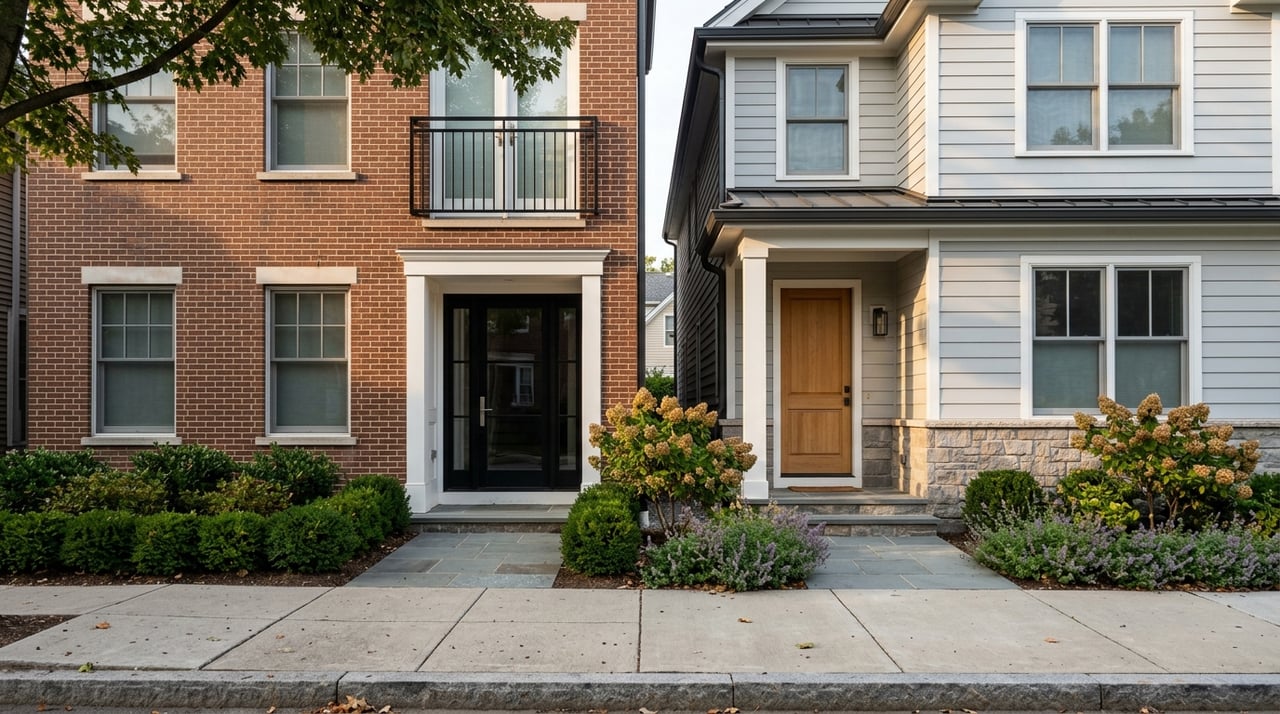
Cambridge Condos vs Single Family: Which Is Right?
June 4, 2026
June 4, 2026
Trying to choose between a Cambridge condo and a single-family home? You are not alone, and in this market, the decision can shape your budget, daily routine, and long-term flexibility in a big way. If you are weighing maintenance, privacy, commute, and total monthly cost, it helps to understand how Cambridge housing actually works on the ground. Let’s dive in.
Cambridge is not a market where condos and single-family homes show up in equal numbers. City data shows that only 6.4% of dwelling units are in 1-unit properties, while 27.6% are condominiums. That matters because scarcity affects both price and your available options.
The price gap is also significant. In Cambridge’s 2024 market-rate sales data, the median condo sale price was $870,000, while the median single-family home sale price was $2,315,000. For many buyers, that makes a condo the more realistic entry point.
Ownership patterns reinforce the same point. Cambridge’s 2020-2024 ACS estimates show 33.5% owner-occupied housing and 66.5% renter-occupied housing. In practical terms, if you want to buy in Cambridge, you will usually see more condo opportunities than detached houses.
Price is the headline, but your monthly carrying cost is what you live with. In Cambridge, the difference between a condo and a single-family home often starts with the sale price and then branches into taxes, dues, insurance, and maintenance.
At the FY26 residential tax rate of $6.67 per $1,000, the city’s median sale prices imply about $5,803 per year in base property tax for a condo and about $15,441 per year for a single-family home. That is a gap of roughly $9,638 per year before the Cambridge residential exemption and the city’s 3% Community Preservation Act surcharge.
If you plan to occupy the home, the Cambridge residential exemption may help reduce your tax burden. The city says owner-occupants can apply, and the filing deadline is April 1 of the fiscal year. That is an important line item to discuss early as you compare options.
Condo ownership adds another cost category: HOA dues. Those dues are separate from your mortgage and typically go directly to the association. A condo may come with a lower purchase price, but the total monthly cost can change quickly depending on dues, reserve funding, and shared building expenses.
Single-family homes usually avoid HOA dues, but they can bring less predictable upkeep costs. As a homeowner, you are responsible for repairs and maintenance, from small plumbing issues to major items like roof replacement. You also need to budget for property taxes, homeowners insurance, utilities, water, and an emergency fund.
A condo is an individually owned unit inside a larger project, with common elements owned collectively by unit owners. That setup changes both your lifestyle and your responsibilities. You own your space, but you also share decision-making through the association structure.
For many buyers, the biggest advantage is lower-maintenance living. Exterior upkeep and common-area maintenance are generally handled through the association, which can be especially appealing if you want a simpler routine or spend a lot of time commuting, traveling, or working.
The tradeoff is less control. HOA boards establish rules about what owners can and cannot do, and project decisions can affect property values. That means your due diligence needs to go beyond the unit itself.
In a Cambridge condo purchase, document review matters. Buyers typically have a limited time after an offer is accepted to review condo documents. A close look at rules, reserves, insurance, pet policies, rental restrictions, and the overall financial health of the association can help you avoid surprises later.
A single-family home usually gives you more direct control over the property. If privacy, outdoor space, or renovation flexibility are high on your list, that can be a major advantage. In Cambridge, though, that added control usually comes with a much higher entry price.
Detached homes also tend to shift more responsibility onto you. There is no association handling the roof, exterior, or shared systems because those responsibilities are yours alone. If something breaks, you decide how to fix it, when to fix it, and how to pay for it.
That autonomy can be worth it if you want more freedom over the property. It can also be the right fit if you know you want private yard space or fewer shared walls. Still, the exact house and lot matter, and the monthly cost may be less predictable than it looks at first glance.
It is easy to focus on square footage and bedroom count, but your day-to-day life matters just as much. In Cambridge, the condo versus single-family decision often comes down to how you want to live.
Condos often make sense if you want a more car-light routine. Cambridge has 27 MBTA bus routes, a commuter rail station, and 6 stations on the MBTA Red and Green Lines. The city also has shuttle options including EZRide, the Loop, and the MT shuttle, which can make certain locations especially practical for buyers who prioritize transit access.
Single-family homes may offer more privacy and more control over outdoor areas, but that does not automatically mean they fit every lifestyle better. A larger property can require more time, more maintenance, and more planning. If convenience and reduced upkeep matter most, a condo may support your goals better.
Shared amenities can also play a role in some condo buildings. On the other hand, a detached home may better suit buyers who want more separation from neighbors. These are general patterns, not guarantees, so the specific property still matters more than the label alone.
Parking is one of those details that can reshape your decision quickly. In Cambridge, limited parking supply affects both condos and single-family homes. You should not assume that a detached house automatically solves parking concerns.
The city says residents and visitors use permit parking areas, and Cambridge operates two municipal garages, nine metered off-street lots, and 3,100 metered street spaces. Because of that, it is smart to verify deeded parking, assigned spaces, guest parking, and resident permit implications before you commit.
This is especially important if you are comparing two homes with similar price points but very different parking setups. A condo with deeded parking may fit your needs better than a single-family home with more uncertainty, or vice versa. The detail matters more than the property type alone.
In Cambridge, your neighborhood choice can be just as important as whether you buy a condo or a single-family home. Submarkets vary widely in housing mix, density, and commuting patterns. That means the same property type can feel very different from one area to another.
West Cambridge is described by the city as a relatively low-density residential neighborhood. Its profile shows 20.5% of units in single-family properties and 56.6% owner occupancy, with a commute pattern that is more car-oriented than the city overall. If you are focused on detached homes, this is the kind of micro-market where your search may feel more aligned.
East Cambridge presents a very different picture. The city’s profile shows just 2.7% single-family units and 75.4% of units in buildings with 26 units or more. If you want condo options in a denser setting, this kind of submarket may offer more inventory that fits your criteria.
Cambridgeport is described as dense and diverse, with Red Line access at Central Square and significant redevelopment along its southeastern edge. North Cambridge sits somewhere in between, with housing types that range from single- and multi-family homes to large apartment buildings. For buyers, that means your search should be framed as both a property-type decision and a neighborhood decision.
If you are trying to narrow the field, start with your priorities rather than the property label. In Cambridge, a condo is often the better fit if your goals center on lower maintenance, a lower purchase price, a more transit-oriented routine, and comfort with HOA rules and dues.
A single-family home may be the better fit if you value privacy, private outdoor space, renovation flexibility, and greater day-to-day control. You also need to be comfortable with a much higher purchase price and the added responsibility of ongoing upkeep.
For many buyers, the best answer is not “condo versus house” in the abstract. It is “which property in which neighborhood best supports the way you want to live.” That is where a local, detail-oriented search becomes especially valuable.
Before you move forward on either property type, focus on the details that most often affect ownership in Cambridge. A careful review upfront can save time, money, and stress later.
Key items to compare include:
These are often the points where one property pulls ahead of another. A home that looks perfect online can feel very different once you understand the building documents, parking setup, or total monthly cost.
If you are comparing Cambridge condos and single-family homes, a measured, neighborhood-specific strategy can make the choice much clearer. Joan Solomont brings a calm, high-touch approach to helping buyers weigh tradeoffs, understand the local market, and move forward with confidence. If you would like tailored guidance, Joan Solomont is here to help.



Reach out to Joan for expert real estate services. Buy, sell, or rent properties with confidence.
Get In Touch With Joan To Learn More

27 BOYLSTON ST STE 310 CHESTNUT HILL MA 02467