West Roxbury's Triple-Deckers Have Been Outside Boston's Condo Rules. A New Docket Could Close That Gap.
October 1, 2026
October 1, 2026
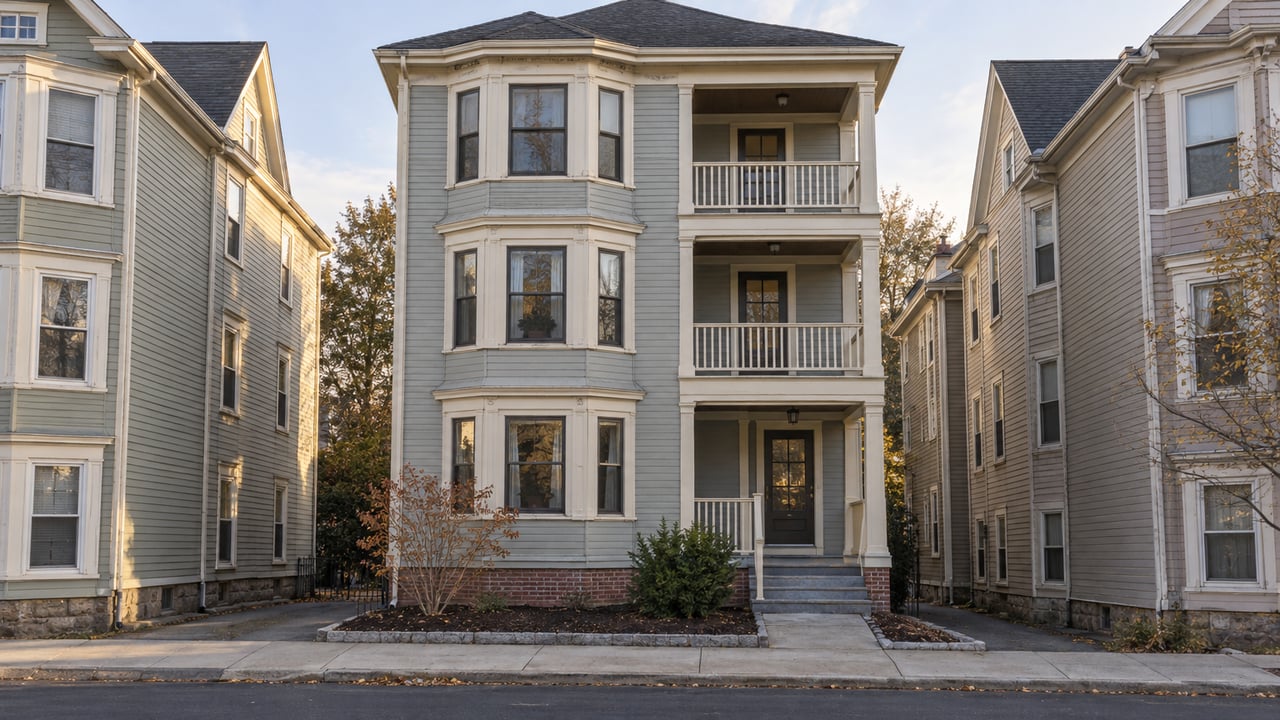
How many rental units does a building need before Boston's tenant protection rules even notice it exists? For nearly three decades, the answer in this city has been four. A landlord converting a 40-unit apartment building into condominiums has had to give tenants a year of notice, in some cases five years, file a formal conversion plan with the Mayor's Office of Housing, and pay the city $1,000 per unit before a single deed changes hands. A landlord converting a triple-decker two blocks away, built the same year, has not.
That gap is not a footnote. West Roxbury's housing stock runs heavily toward two- and three-family homes, the kind of building the city's Condominium and Cooperative Conversion Ordinance has simply never covered. A City Council proposal introduced this month would change that, and the timing matters for anyone in West Roxbury weighing whether to sell a multi-family as-is or convert it first.
Boston's conversion ordinance, adopted in 1999 and amended most recently in 2021, covers residential buildings with four or more rental units that were built or assessed for residential use before December 1983. Owners of covered properties have to secure an Approved Conversion Plan from the Mayor's Office of Housing and a Conversion Permit from Inspectional Services, and they have to give tenants at least a year's notice before conversion. Elderly, disabled, and low-to-moderate income tenants get five years, automatically, longer than the two-to-four year window the state's own condo law provides. Permit fees run $1,000 per unit, and violations carry fines starting at $300 per unit per day.
None of that has applied to a two-family or three-family building. Not because the city decided triple-deckers didn't need protection, but because the four-unit line was inherited from the ordinance's original 1999 scope and has simply never been revisited until now.
The push to close that gap comes with data attached. According to figures released this month by State Senator Lydia Edwards, 101 two- and three-family properties built before 1983 have been converted from rental to condominium citywide, current through this spring. Those conversions produced 317 new condominium units and eliminated 244 apartment units that had been occupied by renters.
Run the arithmetic on those two numbers and something specific shows up. Divide 244 lost apartments across 101 buildings and you get roughly 2.4 rental units per building before conversion, right in line with what a two- or three-family building actually holds. Divide 317 new condos across the same 101 buildings and you get just over 3.1 units per building after conversion. The typical conversion in this dataset didn't just relabel existing apartments as condos. It added close to one additional unit per building, most likely by finishing a basement or converting attic space into a legal fourth unit as part of the master deed process.
In East Boston specifically, where Councilor Gabriela Coletta Zapata has pushed hardest on this issue, the same dataset shows 17 pre-1983 two- and three-family buildings converted as of May 2026, producing 70 new condo units and displacing 42 apartment units. That's roughly the same ratio: conversion tends to add supply while also displacing a comparable number of renter households, and it has happened entirely outside the ordinance that was supposed to give those renters notice and a right of first refusal.
The proposal is Docket #1711, introduced by Council President Liz Breadon and Councilor Coletta Zapata and referred to the Council's Committee on Government Operations, which Coletta Zapata chairs, for hearings and drafting. It would extend the existing ordinance's notice, relocation, and permitting requirements to two- and three-family, non-owner-occupied buildings built before December 1983, closing the exact gap the West Roxbury numbers above illustrate. It would also add a new one-year waiting period between preliminary and final conversion approval specifically for buildings with vacant units, aimed at owners who empty a property before applying so the tenant protections never trigger in the first place.
Breadon has been direct about which neighborhoods this targets. Triple-deckers are, in her words, "critical in a city where triple deckers make up a large share of a naturally affordable housing," and she named West Roxbury alongside Dorchester, Mattapan, Roxbury, Hyde Park, and Roslindale as the areas where this housing type concentrates.
The proposal builds on a 2024 change to state law, the Affordable Homes Act, which first brought non-owner-occupied two- and three-family buildings under Massachusetts' condo conversion statute. Boston's ordinance is catching up to a threshold the state already moved on two years ago.
As of this writing, Docket #1711 has been introduced and referred to committee. No vote has been taken on the ordinance text itself.
For a West Roxbury seller, unit count turns out to matter less than who lives in the building. The proposal as introduced would apply to non-owner-occupied two- and three-family properties. A triple-decker where the owner lives in one unit and rents the other two, a common ownership pattern in this neighborhood, would likely remain outside the ordinance's reach even if Docket #1711 passes exactly as written.
That distinction changes the calculus for two different kinds of sellers in the same neighborhood. An owner-occupant who has lived in one unit for years and wants to sell the whole building to another owner-occupant faces a largely unchanged process. An investor who owns a triple-decker purely as a rental property, with all three units tenanted, is the profile this ordinance is written for, and would face new notice periods, permit requirements, and fees the moment the ordinance passes, if it applies to buildings already mid-conversion or only to new applications going forward is a detail the committee has not yet settled.
| Today: buildings with 4+ units, built before December 1983 | If Docket #1711 passes as introduced: non-owner-occupied 2- and 3-family buildings, built before December 1983 | |
|---|---|---|
| Tenant notice before conversion | One year minimum; five years for elderly, disabled, or low-to-moderate income tenants | Same notice periods would extend to triple-decker and two-family tenants for the first time |
| Conversion approval | Approved Conversion Plan from the Mayor's Office of Housing plus a Conversion Permit from Inspectional Services | Same two-step approval process would apply |
| Permit fee | $1,000 per unit | $1,000 per unit, under the existing fee schedule |
| Vacant-unit waiting period | Not specified beyond standard permitting timelines | A new one-year waiting period between preliminary and final approval |
| Owner-occupied buildings | Outside the unit-count threshold either way | Would remain outside the ordinance under the language as introduced |
Does this affect a triple-decker I already agreed to sell? The ordinance as introduced has not been voted on, so nothing currently in progress is affected by it. Whether a future version would apply to buildings already under a purchase agreement, or only to new conversion applications filed after passage, is a detail the Government Operations committee has not yet resolved.
Does converting to condos before selling still make financial sense? That depends heavily on whether the building is owner-occupied, whether units are currently tenanted or vacant, and how close the committee is to a vote by the time you're ready to list. The math that made sense under the current four-unit threshold may look different under the proposed rule, particularly for a fully tenanted investment property.
Is West Roxbury specifically named in the discussion, or is this a citywide issue that happens to include it? Both. The proposal is citywide, but Council President Breadon named West Roxbury directly, alongside Dorchester, Mattapan, Roxbury, and Hyde Park, as one of the neighborhoods where triple-decker rental stock is concentrated enough to matter to this ordinance's scope.
A triple-decker in West Roxbury sitting under agreement today is operating under rules that have not applied to buildings its size since the ordinance was written. Whether that stays true past this committee cycle is not yet decided, which is precisely why it's worth a conversation before you list, not after.
If you own a two- or three-family property in West Roxbury and want to talk through what a sale or conversion looks like under the current rules, and how Docket #1711 could change that timeline, Joan Solomont offers a complimentary market consultation to walk through the specifics of your building and your options.

Reach out to Joan for expert real estate services. Buy, sell, or rent properties with confidence.
Get In Touch With Joan To Learn More
27 BOYLSTON ST STE 310 CHESTNUT HILL MA 02467